
Background
Music
Aspen Hardwood
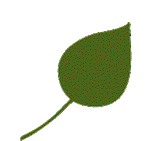
Aspen Leaves

Aspen Wood
SCIENTIFIC NAME(s):
Populus Tremuloides; Populus grandidentata
COMMON NAME(s):
Aspen; Popple; Quaking Aspen; Trembling Aspen; Bigtooth Aspen
GENERAL DESCRIPTION:
Aspen is a generally recognized name that is applied to Bigtooth (Populus grandidentata) and Quaking (Populus tremuloides) Aspen. Aspen does not include Balsam Poplar (Populus balsamifera) and the other species of Populus that are included in the Cottonwoods. The lumber of Aspen and Cottonwood may be mixed in trade and sold as either Popple or Cottonwood. Further, the name Popple should not be confused with Yellow Poplar (Liriodendron tulipifera), also known in the trade as Poplar.
The heartwood of Aspen is grayish white to light grayish brown. Aspen sapwood is white, blending into the light brown heartwood and generally merges gradually into the heartwood without having much contrast. The wood is straight-grained and has a fine, uniform texture. Well-dried aspen lumber does not impart odor or flavor to foodstuffs.
REGIONAL DISTRIBUTION:
Aspen is exclusively a northern species, produced principally in the Northeastern and Lake States, with some production in the Rocky Mountain States.
PHYSICAL PROPERTIES:
Aspen wood is usually straight grained with a fine, uniform texture. It is lightweight and soft, with low bending strength and stiffness, and medium shock resistance. It has a very low-bending classification.
WORKING PROPERTIES:
Aspen is easily worked and does not split when nailed. It machines easily with a slightly fuzzy surface, and turns, bores, and sands well. It takes paint and stain well to produce a good finish, although care is required where the surface is fuzzy. It has a low-to-moderate shrinkage but good dimensional stability.
ALTERNATIVES:
Basswood, Cottonwood, Yellow Poplar
COMMON USES:
Furniture and furniture parts (drawer sides), doors, moulding, picture frames, millwork, toys, kitchen utensils, giftware and matchsticks. Aspen is cut for lumber, pallets, boxes and crating, pulpwood, particleboard, strand panels, excelsior (softwood shavings used for packing fragile goods or stuffing furniture), veneer, and miscellaneous turned articles.
Today, aspen is one of the preferred species for use in oriented strandboard, a panel product that is increasingly being used as sheathing. Specialized uses include sauna laths, due to its low conductivity of heat, and chopsticks.
GRADE:
NHLA Standard Grade Rules
Crafting American Patriotic & Commemorative Flags
For Military Veterans, First Responders & Other Patriots
Made by American Veterans
Using Strictly American Materials