
Background
Music
Basswood Hardwood
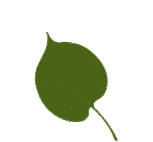
Basswood Leaves

Basswood Wood
SCIENTIFIC NAME(s):
Tilia americana; Tilia heterophylla
COMMON NAME(s):
Basswood, American Linden, American Lime, White Basswood
GENERAL DESCRIPTION:
American Basswood (Tilia americana) is the most important of the native Basswood species; next in importance is White Basswood (T. heterophylla), and no attempt is made to distinguish between these species in lumber form. In commercial usage, “White Basswood” is used to specify the white wood or sapwood of either species.
REGIONAL DISTRIBUTION:
Basswood grows in the eastern half of the United States from the Canadian provinces southward. Most basswood lumber comes from the Lake, Middle Atlantic, and Central States. Northern region Basswood is generally lighter in color than Appalachian region Basswood.
PHYSICAL PROPERTIES:
Basswood is light and soft with generally low strength properties and a poor steam-bending classification. The heartwood of basswood is pale yellowish brown with occasional darker streaks. The sapwood of Basswood is usually quite large and creamy white in color, merging into the heartwood which is pale to reddish brown, sometimes with darker streaks.
The wood has an indistinct grain that is straight and has a fine, uniform texture. When dry, the wood is without odor or taste. It is soft and light in weight, has fine, even texture, and is straight grained and easy to work with tools. Shrinkage in width and thickness during drying is rated as high; however, Basswood seldom warps in use.
WORKING PROPERTIES:
Basswood is the wood of choice for many wood carvers. This lightweight wood works very easily with both hand and power tools. It cuts cleanly, nails, screws, and glues well, although sanding sometimes leaves the surface woolly. Basswood can be painted, stained, and finished to a good smooth finish without difficulty. It dries fairly rapidly with little distortion or degrade and it has fairly high shrinkage with good dimensional stability when dry.
ALTERNATIVES:
Aspen, Yellow Poplar, Cottonwood
COMMON USES:
Piano keys and other musical instruments, picture frames, mouldings, millwork, pattern-making, carvings and giftware. Specialized uses are Venetian blinds and shutters.
GRADE:
NHLA Standard Grade Rules
Crafting American Patriotic & Commemorative Flags
For Military Veterans, First Responders & Other Patriots
Made by American Veterans
Using Strictly American Materials