
Background
Music
Cherry Hardwood
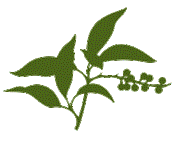
Cherry Leaves

Cherry Wood
SCIENTIFIC NAME(s):
Prunus serotina
COMMON NAME(s):
Cherry, Black Cherry, Wild Cherry
GENERAL DESCRIPTION:
Black cherry (Prunus serotina) is sometimes known as cherry, wild black cherry, and wild cherry. It is the only native species of the genus Prunus of commercial importance for lumber production.
The heartwood of Cherry varies from rich red to reddish brown, will darken with age and on exposure to light and has a distinctive luster. In contrast, the nearly white sapwood is narrow in old-growth trees and wider in second growth trees. The wood has a fine uniform, straight grain, satiny, smooth texture, and may naturally contain brown pith flecks and small gum pockets.
American cherry lumber enchants with its deep, warm tones and refined silky grain. Celebrated for its exceptional workability and resilience, it epitomizes timeless elegance and the rich heritage of American woodworking.
REGIONAL DISTRIBUTION:
Black cherry is found from southeastern Canada throughout the eastern half of the United States. Production is centered chiefly in the Middle Atlantic States. Main commercial areas include Pennsylvania, Virginia, West Virginia, and New York. Northern and Appalachian Cherry are similar. Cherry from Pennsylvania is generally believed to have the best color and lowest gum pocket content.
PHYSICAL PROPERTIES:
Cherry is of medium density with good bending properties, has low stiffness, and medium strength and shock resistance. It is moderately heavy, strong, stiff, and moderately hard; it has high shock resistance and moderately high shrinkage. Black cherry is very dimensionally stable after drying.
WORKING PROPERTIES:
Cherry is easy to machine, nails and glues well, and when sanded and stained, it produces an excellent, smooth finish. It dries fairly quickly with moderately high shrinkage, but dimensionally it is stable after kiln-drying.
ALTERNATIVES:
Soft Maple, White Birch (when both are stained)
COMMON USES:
Flooring, furniture, mouldings and millwork, kitchen cabinets, paneling, doors, boat interiors, musical instruments, turnings and carvings. Other uses include burial caskets, wooden ware, novelties, patterns, and paneling.
GRADE:
NHLA Standard Grade Rules
Crafting American Patriotic & Commemorative Flags
For Military Veterans, First Responders & Other Patriots
Made by American Veterans
Using Strictly American Materials