
Background
Music
Ash Hardwood
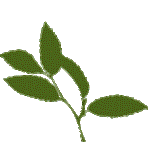
Ash Leaves

Black Ash Wood

White Ash Wood
SCIENTIFIC NAME(s):
Fraxinus nigra; Fraxinus Americana; Fraxinus profunda; Fraxinus Pennsylvanica; Fraxinus Quadrangulata; Fraxinus Latifolia
COMMON NAME(s):
Black Ash; White Ash; Green Ash; Blue Ash; Brown Ash; Tough Ash; Swamp Ash; Olive Ash; Pumpkin Ash; Oregon Ash
GENERAL DESCRIPTION:
Ash exudes charm and sophistication with its naturally pale hue and enchanting open grain textures. Renowned among wood enthusiasts and artisans alike, it offers a winning combination of resilience, aesthetic appeal, and effortless workability, making it a prime selection for woodworking projects.
The sapwood of White Ash is light-colored to nearly white and the heartwood varies from grayish or light brown, to pale yellow streaked with brown. The wood is generally straight-grained with a coarse uniform texture. The degree and availability of light-colored sapwood, and other properties, will vary according to the growing regions.
The heartwood of the White Ash group is brown, and the sapwood is light-colored or nearly white. Second-growth trees are particularly sought after because of the inherent qualities of the wood from these trees: it is heavy, strong, hard, and stiff, and it has high resistance to shock. Oregon Ash has somewhat lower strength properties than American White Ash, but it is used for similar purposes on the West Coast.
The heartwood of Black Ash is a darker brown than that of American White Ash. The sapwood is light-colored or nearly white. The wood of the Black Ash group is lighter in weight than that of the white ash group (less than 50%). Pumpkin Ash, American White Ash, and Green Ash that grow in southern river bottoms, especially in areas frequently flooded for long periods, produce buttresses that contain relatively lightweight and brash wood.
REGIONAL DISTRIBUTION:
Throughout the Eastern U.S. Black Ash grows in the Northeast and Midwest, and Pumpkin Ash in the South. Ash from northern regions will have a higher heartwood content than Appalachian or Southern Ash. Swamp Ash from far Southern states may be too soft in texture for furniture or flooring. However, Swamp Ash weighing less than 2.8 lbs per board foot is in high demand for guitar stock. Oregon ash grows along the Pacific Coast.
PHYSICAL PROPERTIES:
Ash has very good overall strength properties relative to its weight. It has excellent shock resistance and is good for steam bending. Black Ash tends to be a bit darker in color than the White Ash – darker shades can also be seen, which is sometimes sold as Olive Ash.
WORKING PROPERTIES:
Ash machines well, is good in nailing, screwing and gluing, and can be stained to a very good finish. It dries fairly easily with minimal degrade, and there is little movement in performance.
ALTERNATIVES:
Oak, Maple, Hickory
COMMON USES:
Flooring, furniture, doors, architectural millwork and moulding, kitchen cabinets, paneling, baseball bats, mouldings, millwork, boxes/crates, baseball bats, sporting equipment, and other turned objects such as tool handles. It is particularly suitable for food and liquid containers since there is no odor or taste. Principal uses for the Black Ash group are decorative veneer, cabinets, millwork, furniture, cooperage, and crates.
GRADE:
NHLA Standard Grade Rules
Crafting American Patriotic & Commemorative Flags
For Military Veterans, First Responders & Other Patriots
Made by American Veterans
Using Strictly American Materials