
Background
Music
Red Oak Hardwood
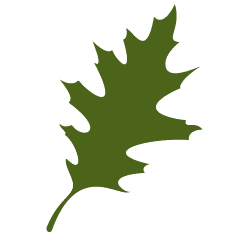
Red Oak Leaves

Red Oak Wood
SCIENTIFIC NAME(s):
Quercus rubra, Quercus coccinea, Quercus shumardii, Quercus palustris, Quercus nuttallii, Quercus velutina, Quercus falcata, Quercus falcata var. pagodaefolia, Quercus nigra, Quercus laurifolia, Quercus phellos
COMMON NAME(s):
Red Oak, Northern Red Oak, Southern Red Oak, Pin Oak, Turkey Oak, Willow Oak, Black Oak, Blackjack Oak, Cherrybark Oak, Laurel Oak, Nuttail Oak & Scarlet Oak
GENERAL DESCRIPTION:
The pride of the American heartland, Red Oak evokes a sense of rugged Americana for woodworkers, with a bold grain, good workability, and timeless appeal.
The sapwood of Red Oak is white to light brown and roughly 2 to 5 cm (1 to 2 in.) wide. The heartwood is a pinkish-reddish brown. The wood is similar in general appearance to White Oak, but with a slightly less-pronounced figure due to the smaller rays. The wood is mostly straight-grained, with a coarse texture. Sawn lumber of the red oak group cannot be separated by species on the basis of wood characteristics alone.
REGIONAL DISTRIBUTION:
Widespread throughout the Eastern United States, Oaks are, by far, the most abundant species group growing in the Eastern hardwood forests. Red Oaks grow more abundantly than White Oaks. The Red Oak group comprises many species, of which about eight are commercial.
Northern Red Oak features tight growth rings, less sapwood and relatively even light heartwood. Red Oak from southern states is often the least expensive and exhibits larger average board sizes. Sapwood, heartwood color variation, mineral streak and wide growth rings are more prevalent in Southern Red Oak. Appalachian Red Oak is a compromise between the northern and southern features.
PHYSICAL PROPERTIES:
Red Oak lumber can be separated from White Oak by the size and arrangement of pores in latewood and because it generally lacks tyloses in the pores. The open pores of Red Oak make this species group unsuitable for tight cooperage, unless the barrels are lined with sealer or plastic. Quartersawn lumber of the Oaks is distinguished by the broad and conspicuous rays. Rapidly grown second-growth wood is generally harder and tougher than finer textured old-growth wood.
Red Oak is hard and heavy, with medium-bending strength and stiffness and high-crushing strength. The Red Oaks have fairly high shrinkage in drying.
WORKING PROPERTIES:
Red Oak machines well, but pre-boring is recommended for nailing and screwing. It can be stained to a golden finish, with a wide range of finish tones.
ALTERNATIVES:
White Oak, White Ash, Hickory
COMMON USES:
Flooring, furniture, architectural millwork and moulding, doors, kitchen cabinets, paneling, and caskets. Lower grade Red Oak is primarily cut into railroad crossties, mine timbers, fence posts, veneer, pulpwood, and fuelwood. Ties, mine timbers, and fence posts require preservative treatment for satisfactory service. Red Oak is also remanufactured into boxes, pallets and crates, agricultural implements, caskets, wooden ware, and handles. It is also used in railroad cars and boats.
GRADE:
NHLA Standard Grade Rules
Crafting American Patriotic & Commemorative Flags
For Military Veterans, First Responders & Other Patriots
Made by American Veterans
Using Strictly American Materials