
Background
Music
White Oak Hardwood
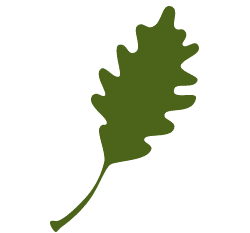
White Oak Leaves

White Oak Wood
SCIENTIFIC NAME(s):
Quercus alba, Quercus spp.
COMMON NAME(s):
White Oak, Chestnut Oak, Mountain Oak, Burr Oak, Blue Oak, Chinkapin Oak, Emory Oak, Gambel Oak, Live Oak, Overcup Oak, Stave Oak, Post Oak & Swamp Oak
GENERAL DESCRIPTION:
White Oak is a large, long-lived deciduous tree native to North America, known for its broad, rounded crown, wide-spreading branches, and distinctive leaves with rounded lobes, typically featuring a light gray bark that can become scaly with age. It produces acorns with a cap that covers about a quarter of the nut, and is valued for its strong, rot-resistant wood.
The tree is large and stately, growing up to over 100 feet tall, and 38 to 50 inches in diameter, with a round to wide spreading irregular crown. It can reach a magnificent height and in the open it develops into a massive broad-topped tree with large branches striking out at wide angles. Some specimens have been documented to be well over 450 years old.
REGIONAL DISTRIBUTION:
White Oak is found widespread throughout the Eastern United States. White Oak lumber comes chiefly from the South, South Atlantic, and Central States, including the southern Appalachian area.
The White Oak group is comprised of many species, of which only about eight are commercial. Principal species are White (Quercus alba), Chestnut (Quercus prinus), Post (Quercus stellata), Overcup (Quercus lyrata), Swamp Chestnut (Quercus michauxii), Bur (Quercus macrocarpa), Chinkapin (Quercus muehlenbergii), Swamp White (Quercus bicolor), and Live (Quercus virginiana) Oak.
Northern White Oak has tight growth rings, less sapwood and slightly darker heartwood. 6-8 foot lengths are more widely available in the North. White Oak is most abundant in the Appalachian/Central region states including Indiana, Ohio, Kentucky, Tennessee & West Virginia. White Oak from Southern states is often the least expensive and exhibits larger average board sizes. Sapwood and wide growth rings are more prevalent in the Southern White Oak.
PHYSICAL PROPERTIES:
White Oak is a hard and heavy wood with a medium-bending and crushing strength, low in stiffness, but very good in steam-bending. It also has great wear-resistance.
White Oak sapwood is light-colored and the heartwood is light-to-dark brown. White Oak is mostly straight-grained with a medium-to-coarse texture. Having longer rays than Red Oak, White Oak has more figure.
The sapwood of White Oaks is nearly white and roughly 2 to 5 cm or more (1 to 2 in. or more) wide. The heartwood is generally grayish brown. Heartwood pores are usually plugged with tyloses, which tend to make the wood impenetrable by liquids. Consequently, most white oaks are suitable for tight cooperage (barrel manufacturing). Many heartwood pores of Chestnut Oak lack tyloses. The wood of White Oak is heavy, averaging somewhat greater in weight than Red Oak wood and the heartwood has good decay resistance.
WORKING PROPERTIES:
White Oak machines well, nails and screws well, although pre-boring is advised. Due to its reaction with iron, galvanized nails are recommended. White Oak’s adhesive properties are variable. The wood dries slowly, but stains to a good finish.
ALTERNATIVES:
Red Oak, White Ash, Hickory
COMMON USES:
White Oaks are usually cut into lumber for furniture building, flooring, architectural millwork, moulding, doors, kitchen cabinets, paneling, and caskets. High-quality White Oak is especially sought after for barrel staves for tight cooperage.
Since Live Oak is considerably heavier and stronger than the other Oaks, it was formerly used extensively for ship timbers. An important use of White Oak is for planking and bent parts of ships and boats, and the heartwood is often specified because of its decay resistance.
Lower quality White Oaks are usually cut into railroad crossties, mine timbers, fence posts, fuelwood, and many other products such as pallets, agricultural implements, railroad cars, and truck floors.
GRADE:
NHLA Standard Grade Rules
Crafting American Patriotic & Commemorative Flags
For Military Veterans, First Responders & Other Patriots
Made by American Veterans
Using Strictly American Materials