
Background
Music
Poplar Hardwood
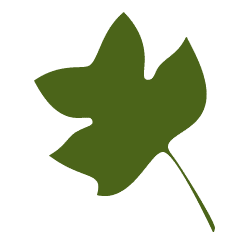
Poplar Leaves

Poplar Wood
SCIENTIFIC NAME(s):
Liriodendron tulipifera
COMMON NAME(s):
Poplar, Yellow Poplar, Tulipwood, Tulip-poplar
GENERAL DESCRIPTION:
Budget-friendly Poplar beats the pants off pine. It is soft but dense, so it is delightfully easy to shape and machine. The tight grain makes Poplar the perfect choice for stains or paint, but it works fine with a clear finish, too.
Sapwood from Poplar is sometimes called White Poplar or Whitewood and frequently several centimeters wide. This sapwood is creamy white and may be streaked. and the heartwood varies from pale yellowish-brown to olive green, sometimes streaked with purple, green, black, blue, or red. These colorations do not affect the physical properties of the wood. The green color in the heartwood will tend to darken on exposure to light and turn brown.
REGIONAL DISTRIBUTION:
Poplar is widespread throughout the Eastern United States. However, it is primarily an Appalachian and Central Region species. It grows from Connecticut and New York southward to Florida and westward to Missouri. The greatest commercial production of Poplar lumber is in the South and Southeast.
PHYSICAL PROPERTIES:
Poplar has a medium-to-fine texture and is straight-grained. Slow-grown wood is moderately light in weight and moderately low in bending strength, moderately soft, and moderately low in shock resistance. The wood has moderately high shrinkage when dried from a green condition, but it is not difficult to dry and is stable after drying. Much of the second-growth wood is heavier, harder, and stronger than that of older trees that have grown more slowly.
WORKING PROPERTIES:
Poplar is a versatile wood that is easy to machine, plane, turn, glue, and bore. It dries easily with minimal movement in performance and has little tendency to split when nailed. It takes and holds paint, enamel, and stain exceptionally well.
ALTERNATIVES:
Basswood, Cottonwood
COMMON USES:
Light construction, furniture, kitchen cabinets, doors, moulding and millwork, edge-glued panels, turnings, and carvings. It is also made into plywood for paneling, piano cases and other musical instruments, and various other structural components. Lower grade Poplar stock is used for making boxes, pallets, and crates.
Crafting American Patriotic & Commemorative Flags
For Military Veterans, First Responders & Other Patriots
Made by American Veterans
Using Strictly American Materials